

Open Cell Spray Foam Insulation in Cerritos, CA
Energy-Saving Open Cell Spray Foam Insulation for Cerritos, CA Homes — Licensed & Insured
Need open cell spray foam insulation in Cerritos, CA? Golden Touch Attic Insulation delivers expert installation, free assessments & SCE rebate help. Call (562) 442-2433.
Open cell spray foam insulation is a high-performance, semi-rigid insulation material that expands on contact to fill cavities, gaps, and irregular surfaces with a soft, sponge-like foam. Unlike traditional batt insulation, open cell spray foam creates an air-tight thermal envelope that dramatically reduces energy loss through walls, attics, and crawl spaces.
In Cerritos, CA, where summer temperatures regularly climb above 95°F and marine layer humidity from nearby Long Beach Harbor pushes moisture into poorly sealed building envelopes, open cell spray foam delivers exceptional thermal and acoustic performance. The city’s housing stock — much of it built between the 1960s and 1990s during Cerritos’s rapid suburban expansion — often contains outdated fiberglass batts that no longer perform to modern energy standards.
Read moreShow less
At Golden Touch Attic Insulation, our team brings deep local knowledge of Cerritos’s microclimates, building codes, and construction styles. Call us today at (562) 442-2433 to schedule your free assessment and discover how open cell spray foam can transform your home’s comfort and efficiency.
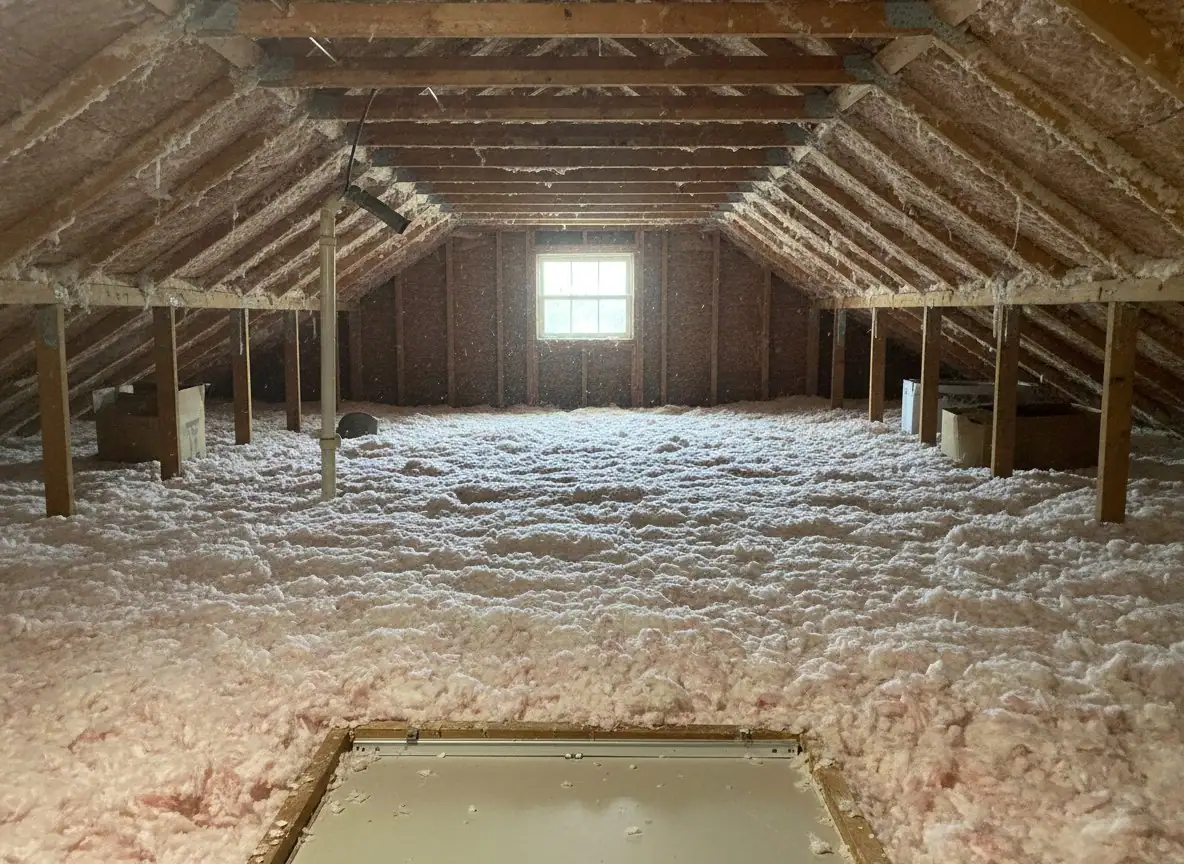
Understanding Open Cell Spray Foam Insulation
Open cell spray foam insulation is a two-component polyurethane product. When the two chemical components — isocyanate and polyol resin — are mixed at the spray nozzle, they react rapidly, expanding up to 100 times their liquid volume within seconds. The resulting foam features billions of tiny open cells that give the material its characteristic soft, spongy texture and its name.
The open-cell structure means the foam allows some vapor permeability, making it a preferred choice for interior applications where moisture management matters — such as attic rafters, interior walls, and crawl spaces with controlled ventilation. It achieves an R-value of approximately R-3.5 to R-3.8 per inch, which, when applied at 5.5 inches, delivers R-20 or higher — meeting and often exceeding California’s Title 24 energy compliance requirements for residential buildings in Climate Zone 8, which covers Cerritos.
Read moreShow less
Historically, open cell spray foam became widely adopted in Southern California during the early 2000s as energy codes tightened following the California energy crisis of 2000–2001. Prior to that period, most Cerritos homes relied on 3.5-inch fiberglass batts in 2×4 stud walls — a system that delivers only R-11 and is riddled with air gaps around electrical boxes, pipes, and framing irregularities.
Open cell foam is particularly well-suited to the wood-framed single-family homes and low-rise apartment complexes that dominate Cerritos’s residential landscape. Because the foam adheres directly to wood framing, drywall, and concrete block, it eliminates convective loops — the hidden air movement inside wall cavities that causes up to 40% of heat transfer in older homes. This makes it an ideal retrofit solution for Cerritos properties built before 1990 that are undergoing renovation or re-roofing projects.
Beyond thermal performance, open cell spray foam provides meaningful sound attenuation. With a Sound Transmission Class (STC) rating improvement of 10–15 points when applied to interior walls, it is increasingly popular in Cerritos homes near the 91 Freeway and Artesia Boulevard, where traffic noise penetrates older construction.
Learn more about our full spray foam insulation services
Why Open Cell Spray Foam Insulation Is Needed in Cerritos, CA
Cerritos’s Climate Zone 8 Thermal Demands
California’s Building Energy Efficiency Standards place Cerritos in Climate Zone 8, characterized by mild, wet winters and warm, dry summers with significant diurnal temperature swings. In July and August, Cerritos regularly records daytime highs between 92°F and 98°F, while nights can drop to the mid-60s°F. This 30°F daily swing forces HVAC systems to cycle repeatedly, driving energy consumption and accelerating wear on equipment. Homes without adequate air sealing — which open cell spray foam uniquely provides — experience stack effect air infiltration that can account for 25–35% of annual heating and cooling costs.
Marine Layer Humidity from the South Bay
Cerritos sits approximately 12 miles northeast of the Pacific Ocean and Long Beach Harbor. The persistent marine layer that moves inland from May through August delivers relative humidity levels of 75–85% in the early morning hours. This moisture infiltrates attic spaces through ridge vents, soffit vents, and penetrations around plumbing stacks and electrical conduits. In homes with older fiberglass or cellulose insulation, this repeated moisture cycling compresses and degrades insulation performance by up to 30% over a 10–15 year period. Open cell spray foam, applied directly to the underside of roof decking in an unvented attic configuration, eliminates this infiltration pathway entirely.
Aging Housing Stock and 1960s–1980s Construction
The vast majority of Cerritos’s residential neighborhoods — including Liberty Park, Bixby Village (along the western boundary), and the tract homes surrounding Pat Nixon Park — were constructed between 1963 and 1985 during the city’s incorporation and rapid build-out period. These homes typically used 2×4 wall framing with R-11 fiberglass batts and minimal attic insulation depths of 3–4 inches. California’s current Title 24 code requires R-38 in attic assemblies and R-13 to R-21 in walls. The gap between existing performance and code minimums is significant, and open cell spray foam is the most efficient single-step remedy for attic applications.
The 1994 Northridge Earthquake Legacy
The January 17, 1994 Northridge Earthquake (Mw 6.7) caused widespread structural damage across Los Angeles County, including in Cerritos. Post-earthquake repairs and retrofits often involved opening wall cavities and attic spaces, but many of these repairs were completed without updating insulation to modern standards. Subsequent settling and micro-cracking of drywall and stucco has created new air infiltration pathways in many affected homes. Open cell spray foam — because it expands to fill irregular gaps and adheres to substrates even after minor movement — provides superior air sealing in these post-retrofit structures compared to batt alternatives.
Proximity to the 91 and 605 Freeway Corridors
Cerritos is bordered by the SR-91 (Artesia Freeway) to the north and the I-605 (San Gabriel River Freeway) to the east. Homes in neighborhoods adjacent to these corridors — particularly those within 1,500 feet of the interchange at Bloomfield Avenue and 183rd Street — experience elevated ambient noise levels of 65–72 dB during peak commute hours. Open cell spray foam’s superior acoustic performance, compared to fiberglass, provides measurable noise reduction for these properties.
Free, no-obligation estimates
Talk to Golden Touch Attic Insulation
Tell us what you need and we’ll take it from there.
Signs You Need Open Cell Spray Foam Insulation in Cerritos
Energy and Comfort Warning Signs
- Monthly electricity bills exceeding $180–$220 during July and August in a typical 1,500–2,000 sq ft Cerritos home
- Rooms above the garage or on the second floor that remain 8–12°F hotter than downstairs living spaces
- HVAC system running continuously for more than 20 minutes per cycle without reaching the thermostat setpoint
- Drafts felt along baseboards, around electrical outlets on exterior walls, or near recessed lighting fixtures
Moisture and Air Quality Indicators
- Musty odors in attic spaces during June through August marine layer season
- Visible moisture staining or mold growth on attic decking or rafters
- Condensation on interior window surfaces during winter mornings when outdoor temperatures drop below 45°F
- Allergy symptoms worsening indoors — a sign of unfiltered outdoor air bypassing HVAC filtration through attic bypasses
Structural and Visual Red Flags
- Existing fiberglass insulation that appears flattened, discolored, or compressed below its original depth
- Visible gaps between insulation batts and framing members in attic knee walls or crawl spaces
- Attic insulation depth measuring less than 10 inches — well below Cerritos’s Title 24 requirement of approximately 15 inches of blown insulation equivalent
Urgency indicator: If you observe any combination of three or more of the above signs, schedule a professional energy audit immediately before the next Cerritos summer peak billing season begins in June.
Our process
Our Open Cell Spray Foam Insulation Process in Cerritos
- 01
Free On-Site Assessment (1–2 Hours)
A Golden Touch Attic Insulation specialist visits your Cerritos property to conduct a thorough visual inspection of the attic, walls, and crawl space. We use a thermal imaging camera to identify hidden air bypasses, moisture intrusion points, and areas of ther
- 02
Scope of Work and Permit Coordination (2–5 Business Days)
We prepare a detailed written scope, including R-value targets, application depths, and any required preparatory work. In Cerritos, spray foam insulation projects in conditioned attic configurations may require a permit from the City of Cerritos Building and S
- 03
Site Preparation (2–4 Hours on Installation Day)
Our crew protects HVAC equipment, electrical panels, and finished surfaces with plastic sheeting. Existing degraded insulation is removed if necessary using our professional insulation removal service. All penetrations — plumbing stacks, electrical conduits, a
- 04
Open Cell Spray Foam Application (3–6 Hours)
Using heated hose equipment calibrated for Cerritos’s typical ambient temperature range of 65–85°F during installation, our certified applicators spray the open cell foam in lifts of 2–3 inches, allowing each lift to cure before adding the next. For attic raft
- 05
Cure Time and Ventilation (24 Hours)
Open cell foam requires a minimum 24-hour cure period before the space is reoccupied. We install temporary ventilation fans in attic spaces to accelerate off-gassing, ensuring indoor air quality meets California OSHA standards before your family returns.
- 06
Quality Inspection and Depth Verification
Using depth probes at a minimum of one measurement per 100 square feet, we verify that installed foam meets specified R-value depths throughout the entire application area. A final thermal scan confirms uniform coverage without cold spots or missed areas.
- 07
Clean-Up and Documentation
All masking materials are removed, the work area is cleaned, and we provide you with a written completion report documenting applied depths, R-values achieved, and any permit final inspection records from the City of Cerritos.
Open Cell Spray Foam Methods and Approaches
Unvented (Hot Roof) Attic Assembly
The most common application in Cerritos, this method involves spraying open cell foam directly to the underside of the roof decking and along the rake walls, converting the attic from a vented unconditioned space to a conditioned semi-conditioned zone. This approach is ideal for homes with HVAC equipment or ductwork located in the attic — which includes the majority of Cerritos tract homes built between 1970 and 1990. By bringing the attic within the thermal envelope, duct leakage losses are eliminated and HVAC efficiency improves by 15–25%.
Interior Wall Cavity Application
For new construction or major renovations, open cell foam is injected into wall cavities before drywall installation. This method is increasingly specified in Cerritos new builds along redeveloping corridors such as South Street and 183rd Street, where multifamily and mixed-use projects require superior acoustic separation between units.
Rim Joist and Crawl Space Application
Cerritos homes with raised foundations benefit significantly from open cell foam applied to rim joists and crawl space walls. This approach is often combined with our crawl space encapsulation service to create a fully conditioned crawl space that eliminates ground moisture infiltration — a particular concern given Cerritos’s position atop the Cerritos clay soil formation, which retains moisture year-round.
Hybrid System: Open Cell Foam Plus Blown-In Insulation
For budget-sensitive projects in older Cerritos homes, we often recommend a hybrid approach: applying 3 inches of open cell foam at the attic floor level for air sealing, followed by our blow-in insulation service to achieve the required R-38 total assembly. This combination delivers 80–90% of the performance of a full spray foam application at a reduced upfront cost.
Open Cell Spray Foam Insulation Cost in Cerritos
Understanding the cost of open cell spray foam insulation helps Cerritos homeowners budget accurately and evaluate competing quotes with confidence.
Typical Price Ranges in Cerritos, CA
- Attic rafter application (unvented assembly): $1.50–$2.25 per board foot, with a typical 1,500 sq ft Cerritos attic at 5.5-inch depth costing $8,250–$12,375 total
- Interior wall cavities (new construction): $1.25–$1.75 per board foot
- Rim joist and crawl space walls: $1,200–$2,800 for a standard Cerritos raised-foundation home depending on perimeter linear footage
- Hybrid open cell plus blown-in system: $3,500–$6,500 for a typical 1,500–1,800 sq ft attic floor application
Read moreShow less
Factors That Affect Your Cerritos Project Cost
- Existing insulation removal: Add $1,200–$2,500 if degraded fiberglass or cellulose must be removed first
- Attic access difficulty: Homes with low-pitch rooflines common in 1970s Cerritos ranch-style construction may require additional labor time
- Permit fees: City of Cerritos building permit fees typically range from $150–$400 depending on project valuation
- SCE rebates: Southern California Edison’s Home Energy Improvement Program may offer rebates of $0.10–$0.20 per square foot for qualifying insulation upgrades, reducing net project cost
Open cell spray foam typically delivers a return on investment within 4–7 years through reduced SCE billing, extended HVAC equipment life, and increased property value. Call (562) 442-2433 for a no-obligation written estimate specific to your Cerritos home.
Cerritos Neighborhoods We Serve
Liberty Park
One of Cerritos’s largest single-family neighborhoods, Liberty Park was developed primarily between 1968 and 1978 with 2×4 framed stucco homes. These properties commonly feature original R-11 fiberglass batts that have compressed and settled over five decades. Open cell spray foam retrofit projects here typically address both attic rafter and wall cavity applications during remodel projects.
Carmenita Road Corridor (West Cerritos)
Homes along and near Carmenita Road represent some of Cerritos’s earliest residential construction, dating to the early 1960s. Many properties here have minimal or no original wall insulation — a discovery that surprises homeowners until they receive their summer SCE bills. This area is also closest to the I-605 noise corridor, making the acoustic benefits of open cell foam especially valuable.
Bloomfield Avenue Area (Central Cerritos)
Central Cerritos neighborhoods near Bloomfield Avenue include a mix of 1970s single-family homes and 1980s–1990s condominium complexes. The condo buildings in this area frequently have shared wall assemblies where open cell foam for acoustic separation is a high-priority upgrade for both owner-occupants and rental investors.
South Cerritos (Near Artesia Border)
Properties in south Cerritos adjacent to Artesia share the city’s lowest elevation and highest marine layer exposure. Moisture-related insulation degradation is most prevalent here, and homeowners consistently report the highest energy bills relative to home size — making open cell spray foam a priority investment in this sub-market.
Maintaining Your Open Cell Spray Foam Insulation in Cerritos
- Annual attic inspection each September: After Cerritos’s peak cooling season, inspect attic spaces for any signs of moisture intrusion, pest activity, or foam damage before the winter rain season begins in November.
- Maintain proper attic ventilation balance: Even in unvented hot-roof assemblies, ensure all mechanical ventilation systems (ERVs or HRVs) are serviced annually to maintain acceptable indoor air quality.
- Protect foam from UV exposure: Open cell foam degrades under prolonged ultraviolet exposure. Ensure any foam visible through skylights or roof access hatches is covered with code-required thermal barriers such as drywall.
- Seal new penetrations immediately: Any new plumbing, electrical, or HVAC penetrations through foam-sealed assemblies must be resealed with compatible foam or caulk within 30 days of installation.
- Monitor SCE bills annually: A sudden increase in summer electricity consumption — above your post-installation baseline — may indicate foam damage, new air infiltration pathways, or HVAC degradation requiring inspection.
- Check crawl space conditions each spring: Cerritos’s winter rains (averaging 13 inches annually) can raise ground moisture levels under raised-foundation homes. Inspect vapor barriers and crawl space foam annually each March or April.
- Keep attic access hatches sealed: Ensure the attic hatch or pull-down stair assembly remains weather-stripped and insulated to prevent bypassing the spray foam thermal envelope.
Why Choose Golden Touch Attic Insulation in Cerritos
Golden Touch Attic Insulation is a locally focused insulation contractor serving Cerritos and the surrounding communities of the Southeast Los Angeles and North Orange County region. Our team has direct, hands-on experience with the specific construction styles, energy code requirements, and climate challenges that define Cerritos properties.
We specialize exclusively in insulation services — including attic insulation, spray foam insulation, crawl space insulation, and insulation removal — which means every technician on your project is a trained insulation specialist, not a generalist contractor moonlighting in insulation work.
Our project approach emphasizes transparent, written scoping documents before any work begins, so Cerritos homeowners always know exactly what they are receiving and at what cost. We work directly with Southern California Edison’s rebate programs to help you maximize available incentives, and we coordinate all City of Cerritos building permits on your behalf.
Read moreShow less
We serve not just Cerritos but the broader Southeast LA and North OC region, including Bellflower, Artesia, Downey, Norwalk, La Mirada, Lakewood, Hawaiian Gardens, Paramount, Santa Fe Springs, Signal Hill, Whittier, Buena Park, Cypress, La Palma, Los Alamitos, and Stanton.
Call (562) 442-2433 to speak with a Cerritos insulation specialist today.
FAQ
Frequently Asked Questions: Open Cell Spray Foam Insulation in Cerritos
How much does open cell spray foam insulation cost in Cerritos, CA?
In Cerritos, open cell spray foam typically costs $1.50–$2.25 per board foot for attic rafter applications. A standard 1,500 square foot attic treated at 5.5 inches deep will generally cost between $8,250 and $12,375 before permit fees and any removal of existing insulation. Rim joist and crawl space applications run $1,200–$2,800 for most Cerritos raised-foundation homes. SCE rebates may reduce your net cost. Contact us at (562) 442-2433 for a precise written quote.
Is open cell or closed cell spray foam better for Cerritos homes?
For most interior attic and wall applications in Cerritos, open cell foam is the preferred choice because it allows some vapor permeability — important in Climate Zone 8 where moisture management in wall assemblies matters. Closed cell foam is recommended for exterior or below-grade applications, such as foundation walls and exterior sheathing, where a Class II vapor retarder is required by California Building Code. Our specialists will recommend the right product for your specific assembly during your free assessment.
How long does a spray foam insulation project take in Cerritos?
Most residential open cell spray foam projects in Cerritos are completed in one to two days. Attic applications for homes under 2,000 square feet typically require four to six hours of spray time. Add 24 hours for full foam cure and off-gassing ventilation before the space is reoccupied. Permit processing by the City of Cerritos Building and Safety Division typically adds two to five business days before work can begin.
Will spray foam insulation help with noise from the 91 Freeway near my Cerritos home?
Yes. Open cell spray foam improves the Sound Transmission Class (STC) rating of wall and attic assemblies by 10–15 points. For Cerritos homes within 1,500 feet of the SR-91 or I-605 interchange, spray foam applied to attic rafters and exterior-facing wall cavities delivers measurable reductions in traffic noise penetration — a benefit that fiberglass insulation cannot match due to its air-permeable nature.
Do I need a permit for spray foam insulation in Cerritos?
It depends on the scope of work. Converting an existing vented attic to an unvented conditioned attic assembly using spray foam at the roof deck typically requires a building permit from the City of Cerritos. Spot air sealing and supplemental insulation additions may not. Golden Touch Attic Insulation determines permit requirements for each project and handles all permit applications on your behalf at no additional administrative fee.
How soon will I see savings on my SCE bill after spray foam installation?
Most Cerritos homeowners report a noticeable reduction in their Southern California Edison bills within the first full billing cycle after installation. Measured average savings in Climate Zone 8 homes with properly installed open cell attic foam range from 15–30% of annual HVAC-related energy costs. In a Cerritos home spending $220 per month on electricity in summer, that represents $33–$66 in monthly savings — every month.
Can open cell spray foam be installed over existing insulation in my Cerritos attic?
In some cases, yes. If existing attic floor insulation is in good condition and dry, our team may install open cell foam at the rafter level above it without full removal. However, if existing fiberglass is compressed, moisture-damaged, or contaminated — common in Cerritos homes that have experienced marine layer moisture infiltration over 20+ years — removal is necessary before spray foam application to ensure proper adhesion and prevent moisture entrapment.
Does open cell spray foam meet California Title 24 requirements in Cerritos?
Yes. Open cell spray foam applied at 5.5 inches at the rafter plane (delivering R-20 to R-22) meets or exceeds Title 24 2022 prescriptive requirements for unvented attic assemblies in Cerritos’s Climate Zone 8. For wall assemblies, 3.5 inches of open cell foam in a 2×4 cavity delivers R-13, meeting the minimum wall prescriptive requirement. We provide Title 24 documentation for all applicable projects.
Ready to Transform Your Cerritos Home with Open Cell Spray Foam?
If you’re tired of high SCE bills, uneven room temperatures, or outdoor noise penetrating your Cerritos home, open cell spray foam insulation from Golden Touch Attic Insulation is your solution. Our Cerritos-focused team is ready to assess your property, explain your options in plain language, and deliver expert installation that meets California Title 24 standards.
Don’t wait until the next Cerritos summer heat wave to address your home’s insulation gaps. Contact us today for your free, no-obligation on-site assessment.
- Call or Text: (562) 442-2433
- Service Area: Cerritos and surrounding communities throughout Southeast LA and North Orange County
Golden Touch Attic Insulation — Cerritos’s trusted open cell spray foam insulation specialists. Call (562) 442-2433 now and let’s get started.
Get in touch
Find insulation help near you
Request a free estimate online or give us a call — our team will follow up quickly.
- Call us(562) 442-2433
- Visit13810 Bentley Pl, Cerritos, CA 90703
- HoursMon-Sun 07:00-19:00